
A mystery shopping wave produces comparable data only when every shopper does the same thing in every store. This guide shows how to brief mystery shoppers for a wave, with one worked example throughout: a phone-accessory retailer with 40 stores and the scenario "ask for a case for a two-year-old phone model and a screen protector, buy the protector if it costs under EUR 15". The retailer and the numbers are made up; the method is what holds up in practice.
What a brief has to achieve
The client wants to know whether the employee asks which phone model the customer owns, whether a screen protector is suggested unprompted, and whether fitting is offered. Those answers can only be compared across 40 stores if all 40 customers behaved the same way.
Suppose shopper 17 asks about a case for this year's flagship instead. The employee walks straight to the wall, because current models are always in stock, and never asks about the model. Store 17 scores lower on "asked for the model", and the client cannot tell whether that is the store or the shopper. The visit is paid for and cannot be used. One deviation makes a visit incomparable; the brief exists to prevent it.
The brief's second job is to bring back facts the validator can check: times, counts, a receipt, photos. "The service was fine" verifies nothing.
How to brief mystery shoppers: the six parts
Scenario and persona
Write it as a script the shopper can rehearse:
- Who you are: a customer who owns the phone model named in your assignment. Do not swap it for your own phone.
- What you ask: "Do you have a case for this model?" Wait for the answer. Then: "And a screen protector?"
- What you buy: the screen protector, if it costs under EUR 15. Do not buy the case. At EUR 15 or more, say "I will think about it" and leave.
- Budget: EUR 15, reimbursed against the receipt only.
- Unscripted questions: answer as a normal customer would and keep it short. "Which color?" "Black." "Tempered glass or film?" "What is the difference?" Do not volunteer anything.
Most deviations happen because the employee asked something the script did not cover and the shopper improvised. One line on how to handle that removes most of the problem.
Visit window
Give a date range, a time range and the exceptions. Example: March 2 to March 20, between 10:00 and 12:00 or between 15:00 and 17:00, not on March 3 (public holiday) or March 9 (a promotion launch, when stores push accessories anyway). State what to do if the store is closed: call the office, do not visit a different store, do not come back the next day without telling anyone.
In Shopper-X excluded dates are a wave setting and each audit in the schedule carries its own period and time range, so the window travels with the assignment.
Observe, then judge
Ask for facts first and opinions last. Facts: was a greeting offered within one minute of entering; did the employee ask which model you own; was fitting offered; how many demo units were powered on. Opinion: was the employee friendly. Tell the shopper to note the times (entering, first greeting, leaving) and put the rating questions at the end, so the visit is reconstructed before the shopper is asked how it felt.
Evidence
List exactly what to bring back: the receipt with date, store and amount readable; one photo of the accessory wall from the aisle; one photo of the storefront with the sign. Describe staff by role and appearance ("the employee at the till, man, dark shirt, about 30"), not by name, unless the client has explicitly allowed names. Most clients want to coach a store, not discipline a person. The photo evidence guide covers what makes a photo usable.
Rules
Three rules belong in every brief. Never reveal the visit, even if asked directly; the answer to "are you a mystery shopper?" is "no, just looking for a case". No notes and no typing on your phone inside the store; write the report within 30 minutes of leaving. Submit within the fill-in deadline, for example 24 hours after the visit; detail fades and the validator queue is planned around it.
Who to call when something goes wrong
A name, a phone number and the hours it is answered. Name the cases that justify a call: the store is closed, an employee recognizes the shopper, or the store does not stock protectors for that model at all. While waiting: leave the store, no second attempt.
Put the instruction next to the question
A brief sent as a PDF is read once, usually the evening before. By the time the shopper is filling in question 12 in a parking lot, the detail is gone. Attach the instruction to the question itself.
Example: Q12 asks for the number of demo units. The instruction next to it says "Count the demo units. Count only powered-on units." Q4 asks for the time to greeting: "Start counting when you cross the entrance. Stop at the first word addressed to you, by any employee." Without the second sentence, half the shoppers stop the clock at eye contact.
In the Shopper-X questionnaire editor each question carries a chosen instruction text, a "comment required" flag and a "photo required" setting with a count. The shopper sees that text with the question while filling in. The full brief can still be attached as an instruction file; the per-question text is the part that gets read twice.
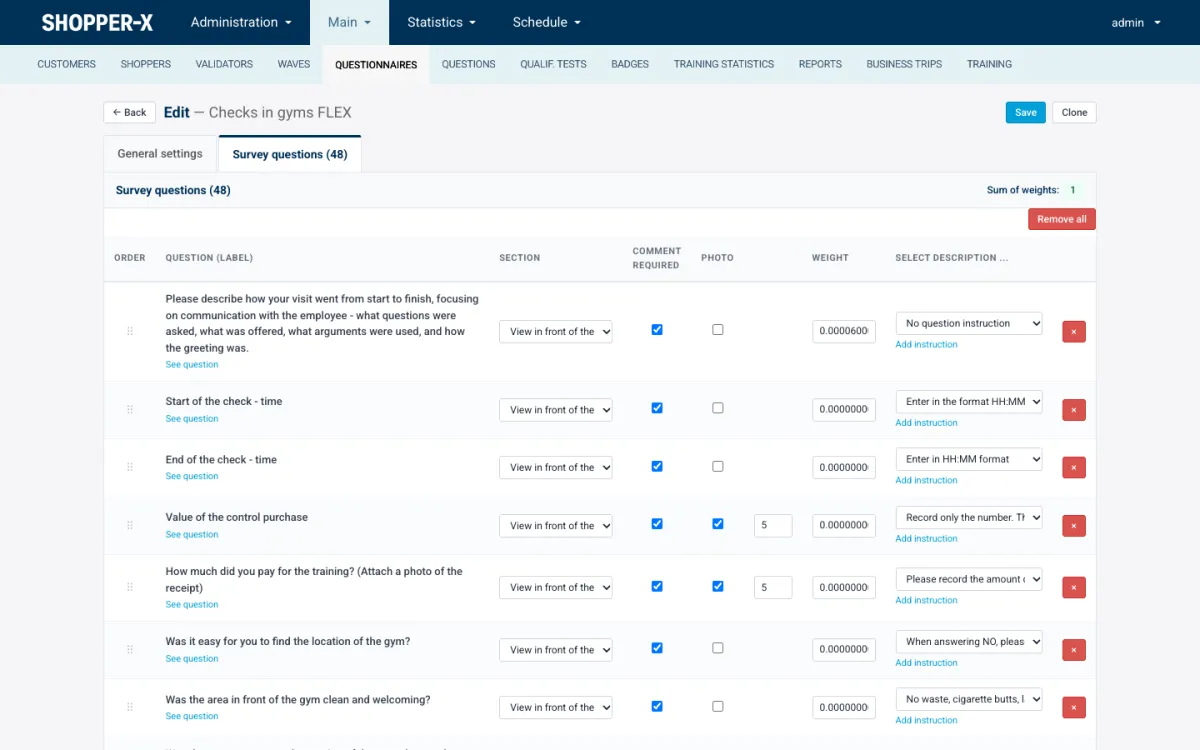
Every question that was ever misread in a returned report gets an instruction. The questionnaire design guide covers question types and weights; the editor settings are on the questionnaire builder page.
Check understanding with a short test
Eight to ten multiple-choice questions taken from the brief settle it: Which phone model do you ask about? The protector costs EUR 17, what do you do? The store is closed, what do you do? Which demo units do you count? Make the wrong answers the real mistakes; a distractor nobody would pick tests nothing.
Set the pass mark at 90%, which on ten questions means at most one error. A failed test is retaken immediately, with the brief open. In Shopper-X a questionnaire can require a passed test before the shopper can fill in a report, so a failed test blocks the visit instead of producing a bad one. First-time shoppers pass a general entry test at 100% (the onboarding rules, valid for twelve months) before any scenario test. The training statistics page shows pass rates, retakes and which scenarios give shoppers the most trouble, which usually means the brief wording needs fixing.
Suppose six of 40 shoppers fail the first attempt, four of them on the EUR 17 question. Without the test, the client pays for four visits where the price threshold was never tested. With it, the brief gets one clearer sentence and the four retake it that evening.
The reaction deadline is part of the brief
Two timing rules belong in the assignment email itself. First, the shopper accepts with a visit date or rejects with a reason within the reaction time, for example 48 hours. Second, no rejection or rescheduling less than two days before the visit date. Say why: with 40 stores in three weeks, a replacement shopper needs time to prepare and pass the same test.
In Shopper-X the reaction time and fill-in time are set per wave, each audit in the inbox shows both deadlines, and the two-day rule is enforced on the web and in the app. Reaction status (waiting, overdue, reacted) is tracked separately from report status, so the schedule shows who has not answered before it becomes a missed visit. The assignment email text is editable.
Mystery shopper brief template
Copy this list and fill every line; write "not applicable" where a line does not apply.
- Scenario: one paragraph on what the visit is about and what the client wants to learn.
- Persona: who you are, what you own, how you answer unscripted questions.
- Script: the exact questions to ask, in order.
- Purchase: what to buy, the price limit, what to do above it, the reimbursement rule.
- Window: date range, time range, excluded dates, what to do if the store is closed.
- Evidence: receipt, each required photo with what must be visible, how to describe staff.
- Rules: never reveal the visit, no notes in store, submit within the fill-in deadline.
- Contact: name, number, hours, the cases that justify a call.
- Deadlines: reaction time, two-day rule, fill-in deadline, the test to pass first.
Four common failures and the wording that prevents them
| What goes wrong | Wording that prevents it |
|---|---|
| The employee asks an unscripted question and the shopper invents a story about a cracked screen, which changes the sales conversation. | "If asked anything not in the script, answer in one short sentence as a normal customer would." |
| The visit happens at 13:15 on a Saturday, with a queue, although the brief said off-peak. "Off-peak" is a judgement. | "Visit between 10:00 and 12:00 or between 15:00 and 17:00, Monday to Friday. If more than three customers are waiting, leave and come back inside the window." |
| The photo shows the shop window from the street, not the accessory wall. "Photo of the store" was not specific. | "Photo 2: the accessory wall, from the aisle, with at least five product hooks visible." |
| Q7 "Did the employee ask which model you own?" is answered "He was quite helpful." | Per-question instruction: "Yes only if the employee asked for the model before showing a case. Write the words used in the comment." |
FAQ
How long should a mystery shopper briefing be?
One page, around 400 to 600 words, plus the per-question instructions inside the questionnaire. A longer document gets skimmed; extra material belongs in the test.
Do shoppers need a briefing call?
Not for a scenario like the phone-accessory wave, if the written brief and the test exist. A call helps on the first wave with a new client or when the scenario has branches, such as a bank product consultation. Add the questions people asked to the brief.
What if the shopper cannot complete the scenario?
The shopper reports what happened and does not substitute a different scenario. "No protectors stocked for that model" is itself a finding. If the whole visit is blocked, the shopper calls the contact number and leaves; the project manager reschedules or reassigns.
Related reading
- How to design a mystery shopping questionnaire with a usable score
- Mystery shopping photo evidence: what to ask for and what to reject
- Mystery shopping report validation checklist
To see per-question instructions, tests and reaction deadlines on a real wave, request a demo with your own scenario.