
The in-house vs agency mystery shopping question is usually answered by whoever is asked. Agencies list what you would have to build; software vendors list what an agency charges for. This post is written for the brand side and adds the option most comparisons leave out: an in-house team on a licensed platform with its own shopper pool. The worked example is a brand with 40 stores and two visits per store per quarter: 80 reports per wave, four waves a year, and about 300 photos per wave to receive, check and store.
Three models, not two
Agency-managed. The brand agrees on a scenario and a questionnaire; the agency does everything else and delivers validated reports and a dashboard. The brand pays per visit.
In-house with own shoppers and own tools. The brand recruits shoppers itself, briefs them by email, keeps the schedule in a spreadsheet, collects reports through a form tool and pays through accounts payable. No platform fee; every process is run by staff.
In-house on a licensed platform. The brand runs the program itself, on software that already holds the schedule, the questionnaire, the shopper pool, the validation step and the payment periods. The shoppers can be external freelancers, the brand's own field staff, or both.
Most articles compare the first two and conclude that the agency wins unless the program is tiny. The third model changes the trade-off: the part that makes in-house expensive, running the process, is what the platform supplies.
What the agency does for its fee
Before bringing a program in-house, write down what the agency does for its fee.
- Recruitment and qualification. Finding shoppers in every city, matching them to the target customer, testing them on the scenario, replacing drop-outs.
- Briefing. Turning the questionnaire into instructions a shopper can follow and answering questions before the visit.
- Scheduling. Assigning 80 visits with deadlines, chasing acceptances, reassigning when a store closes.
- Validation. Reading every report before the brand sees it, returning thin ones, checking that the photos show what the answer claims.
- Payment. Collecting bank details, paying monthly, settling disputes over rejected visits.
- Reporting. Scores by store, region and wave, in a format the regional managers will open.
The agency also sells independence. Wherever a bonus depends on the score, the people grading a branch must not report to the person who runs it. An in-house program can be independent too, but it has to be designed in: validators outside the regional line, shoppers who were never employees, a questionnaire nobody in the store sees in advance. If the program feeds an incentive scheme or a regulator, independence is a hard requirement.
What breaks in-house without tooling: the 80-report wave
The second model fails predictably. Wave one goes fine; the problems compound from wave two.
The schedule. 80 rows with store, shopper, visit window, deadline and status. Every change arrives by message and someone types it in. By mid-wave the sheet and reality disagree on about one row in ten.
The briefs. The scenario goes out as a PDF. Version two follows three days later with a changed price limit. Half the shoppers visit on the old brief.
The photos. 300 photos arrive in chat threads and email. Twenty are missing, fifteen are filed under the wrong store, and the compressed ones are too small to read a price label.
The validation step. There is none, because nobody owns it. Reports go straight from the form tool into the dashboard, and the first time a regional manager finds one that says the store was open on a day it was closed for inventory, every number loses credibility.
The payments. 80 visit fees plus travel costs for twelve shoppers, reconciled by hand against the sheet. A shopper paid for a visit that is later rejected is asked to return the money, and quits.
Count the hours. At roughly 15 minutes of coordination per visit, 20 minutes to check each report and a day for payments, one wave takes around 60 staff hours before anyone has looked at a result. Four waves a year is a third of a full-time job for someone hired to do something else. The usual outcome is that the program quietly shrinks to one visit per store, then to the easy stores.
Decision table
Six factors decide the model. When they pull in different directions, the hybrid below is usually the answer.
| Factor | Agency | In-house, own tools | In-house on a platform |
|---|---|---|---|
| Visits per year | Any volume; cost scales with it | Up to about 100 before the sheet breaks | From a few hundred up; the fixed cost spreads |
| Locations and countries | Network covers cities you have no staff in | One country, cities where you can recruit personally | Anywhere you can recruit; one schedule, one pool |
| Languages | Local shoppers and translation included | Whatever your team speaks | Interface and questionnaire per language |
| Need for independence | Built in | Hard to prove | Possible with external shoppers and independent validators |
| Staff time available | Half a day per wave | Several days per wave | One to two days per wave, mostly validation |
| Data ownership | Agency holds history and pool; exports on request | Yours, scattered across tools | Yours, in one database, with exports and an API |
A brand with 300 stores in five countries and no field team belongs with an agency. A brand with 40 stores, a field team that already visits every store and a monthly compliance checklist should not pay agency rates for an internal audit.
The hybrid: own the platform, mix the shoppers
The models are not exclusive. A brand can own the platform and the data and decide per visit type who performs the visit.
- Compliance visits by own field staff. Price labels, promotional displays, opening hours, cleanliness, signage. These need a photo and a checklist, not a secret customer. The area managers who already drive between stores get shopper accounts, pick the visits up from their inbox and submit the report with photos from the phone. No fee, no travel claims, same validation as every other report.
- Customer-experience visits by external shoppers. Greeting, needs discovery, recommendation, closing. These need someone the staff do not recognize. External shoppers get the same accounts, form and deadlines and are paid through the platform's payment periods.
- An agency where you need one. For the countries where you cannot recruit, or the regulated line of business where independence must be documented. Either the brand gets a client login on the agency's installation, or the agency's staff get accounts on the brand's installation limited to the waves they run.
Shopper-X is built this way: one installation serves many customers, each seeing only its own data, and a shopper account works the same whether it belongs to a freelancer or an area manager. The mystery shopping software overview describes the roles.
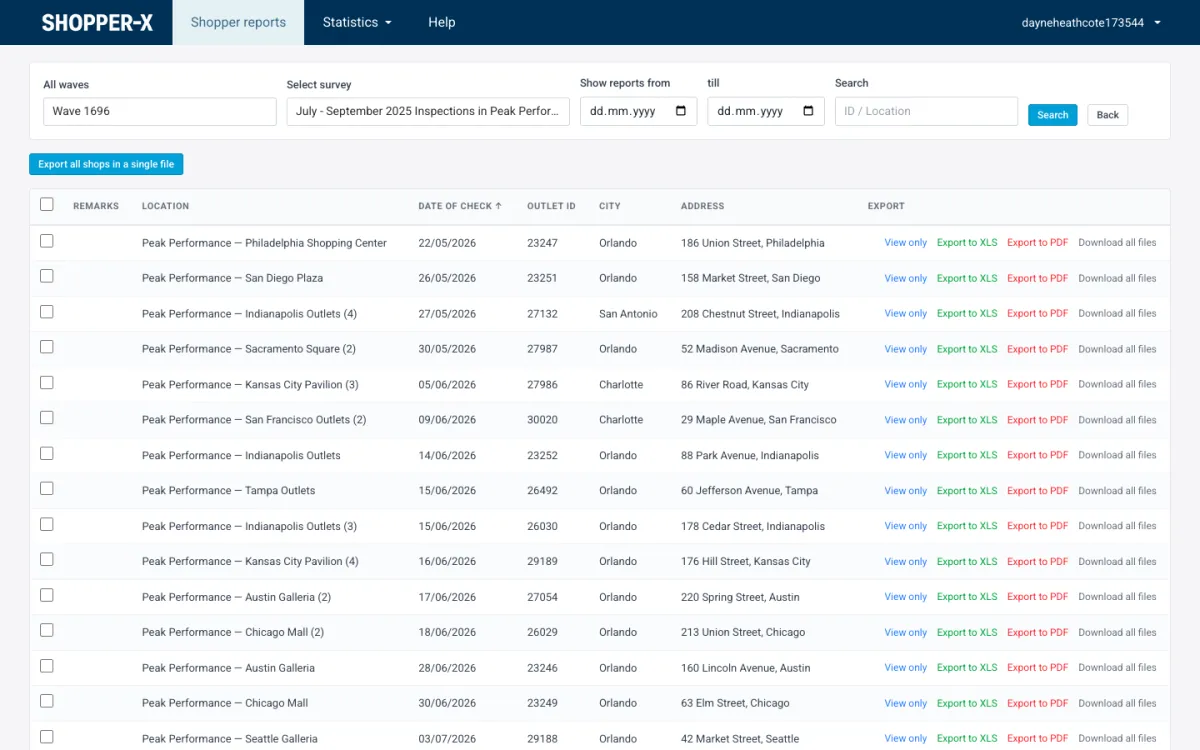
The screen above is the client's individual reports list: one row per validated visit, with exports per row or for the whole wave.
Switching costs: who owns what
Three questions set the cost of changing model later.
- Who owns the questionnaire? Some agency contracts treat the questionnaire and its weights as the agency's methodology. Leave, and you start from a blank page with no way to compare new results with old. Ask for it as a document, with weights, before signing.
- Who owns the history? Three years of scores by store are worth more than the next wave. The contract should say the full report set, photos and comments included, is exported to you at the end: XLSX for the data, PDF or HTML per report, a ZIP of files per visit.
- Who owns the shopper database? Usually the agency, and rightly so. But if your own field staff did compliance visits in the agency's tool, their accounts and training records leave with it.
On a platform you license, all three stay with you. Shopper-X exports any report to XLSX, PDF and HTML, exports all reports of a questionnaire into one file, and has a versioned REST API with per-client API keys for integrators. If the software selection is still open, put the exports and the API on the requirements list and ask to see them work.
A cost framework with placeholders
No figures here are market rates; put your own numbers in.
- Agency: visits per year × per-visit fee (V × F), plus any setup fee per wave, plus about half a day of your time per wave.
- In-house, own tools: visits per year × shopper fee (V × S), plus staff hours per wave × waves × internal hourly cost (H × W × R). Start with the 60 hours per wave from the example as H.
- In-house on a platform: the platform cost for the year (P), plus V × S for external shoppers (zero for visits done by own staff), plus a smaller H × W × R, mostly validation time.
For the 40-store example, V is 320 and W is 4. If the compliance half is done by area managers, V × S halves. The platform line wins only when P is smaller than the staff hours it removes plus the agency margin it replaces. Below about 100 visits a year it rarely is. Do not forget validation time: the agency's is inside its fee, yours is on the payroll.
FAQ
Can a brand run its own shoppers on Shopper-X?
Yes. Shoppers self-register with email verification, complete a profile and a qualification test, and an administrator approves them. The brand's team acts as administrator and either validates reports itself or creates validator accounts for a separate group.
Can an agency and a brand share one installation?
Yes. The platform is multi-client. The agency runs it as administrator and the brand gets a client login scoped to its own reports and statistics. The reverse also works: the brand runs the installation and gives the agency's staff accounts limited to the waves they run.
Who validates reports in-house?
Someone who did not schedule the visit and does not manage the stores visited, for example the CX manager for external shoppers' reports and an operations analyst for the field team's compliance reports. The validator checks every answer, comment and photo, returns the report for corrections when needed and marks it validated. The validation checklist covers what to look for.
Related reading
- How to run a mystery shopping program
- How to choose mystery shopping software
- How to recruit and retain mystery shoppers
To see how a brand's team, its field staff and an agency can share one installation, request a demo with your store list.