
Bank mystery shopping software has to do two things a retail audit tool does not: hold a narrative of what the advisor said about fees, rates and conditions, and keep that narrative under control, because the answers carry compliance weight and often personal data. Shopper-X gives agencies and in-house teams running branch programs a questionnaire that forces the detail a compliance reviewer needs, a validator who checks every report before the bank sees it, and a client portal where regional heads compare branches on one scale. The full platform is on the product page.
What a bank branch mystery shopping program needs
A typical branch wave has one or two scenarios, an account inquiry and a loan inquiry, visited once per branch per quarter and read by compliance, the network head and the branch manager. The items to measure:
- Wait and queue handling. Time of entry, time greeted, time with an advisor, whether the queue system worked. Recorded as times, not impressions.
- Needs assessment before the offer. Did the advisor ask about income, purpose and existing products before naming a product? A yes/no item with a required comment quoting the questions asked.
- Mandatory disclosures. The fee named without prompting, the interest rate with its conditions, the early repayment charge, the terms document handed over, identification requested where the process requires it. Compliance reads these first, and a missed one should fail the visit.
- Cross-sell and the close. Was a second product (card, savings, insurance) offered, and was it relevant? Were contact details taken and a next step proposed?
- Follow-up. If a callback or an appointment was promised, did it happen and when? A second checkpoint days after the visit.
Two constraints shape the rest. Many banks do not allow photos inside the branch, so the evidence is the times, the brochure and the narrative. And the shopper may have to give a real name, so the report holds data that must not reach a client export.
How Shopper-X handles it
Questionnaire rules that enforce the detail
In the questionnaire builder every question has a section, a weight, an optional required comment and a minimum comment length. The advisor conversation goes into open text with a minimum length, so "explained the fees" is not an answer; the report editor checks the length and marks the answer "Enough symbols" once it is met. Disclosure items are marked disqualifying or critical: a wrong answer on a disqualifying question disqualifies the whole report, and both flags are checked by the same submission rules on web and mobile. A points question can require a comment at the maximum score, so a perfect score on "explained the conditions" arrives with the wording that earned it. Questions holding the advisor's name or the identity the shopper used are flagged as containing private data and hidden in the export. Photos are required per question with a count, so the facade is required and the inside of the branch is not. For the writing side, see how to design a mystery shopping questionnaire.
Branches as locations, districts and zones
Each branch is a location under the bank with a city, a district and an optional zone, imported from CSV or XLSX. A regional head filters statistics to a district; the network head compares zones. In the schedule the quarter's visits form a wave with a date range, and the next quarter starts as a clone of the previous wave's schedule, with the branches, custom fields and shopper settings carried over. Each audit carries a time range (a lunchtime visit and a late afternoon visit are different scenarios), a reaction deadline and a fill-in deadline. Custom fields per audit hold the product to ask about and the bank's own branch code.
Shoppers who fit the scenario
A shopper profile records relationships with companies, so a scenario that needs a non-customer of the bank, or an existing customer for a service inquiry, is filled from the right pool, and the bank's restricted-shoppers list keeps named people out. Eligibility rules per wave or questionnaire gate by age and city, so a mortgage inquiry goes to shoppers of a plausible age who live near the branch. A questionnaire can require a passed instruction test before fill-in, so the compliance briefing is tested, not assumed. More under shopper management.
Validation before the bank sees anything
A bank reads only reports a validator has approved. In the validator editor every answer has an accept toggle and a remark; a thin narrative or times that do not add up go back to the shopper with "return for corrections". Two reviewers cannot edit the same report at once, and every status change, score and remark is logged. Personal numbers, ID card data and IBANs are encrypted at rest. Administrator accounts are limited through permission groups, and an audit log records every permission check: the answer when the bank's security team asks who could open the reports.
Validated audits go into a monthly payment period with the fee per audit, exported as a multi-sheet Excel file with a fee notification email to each shopper.
A sample branch questionnaire, by section
- Arrival and waiting: time of entry, queue system, time to first contact, acknowledgment while waiting
- Advisor and needs assessment: greeting, questions asked before the offer, privacy of the conversation
- Product presentation: the product explained, comparison with an alternative, printed terms handed over
- Mandatory disclosures: fee, rate and conditions, early repayment, identification; disqualifying and critical items
- Cross-sell and close: second product offered, relevance, contact details taken, next step proposed
- Branch environment: facade and opening hours (photo required), signage, ATM area, brochures available
- Follow-up: callback or appointment promised, received, within the agreed time
- Private data: advisor name, identity used (flagged private, hidden in export)
Reporting the client sees
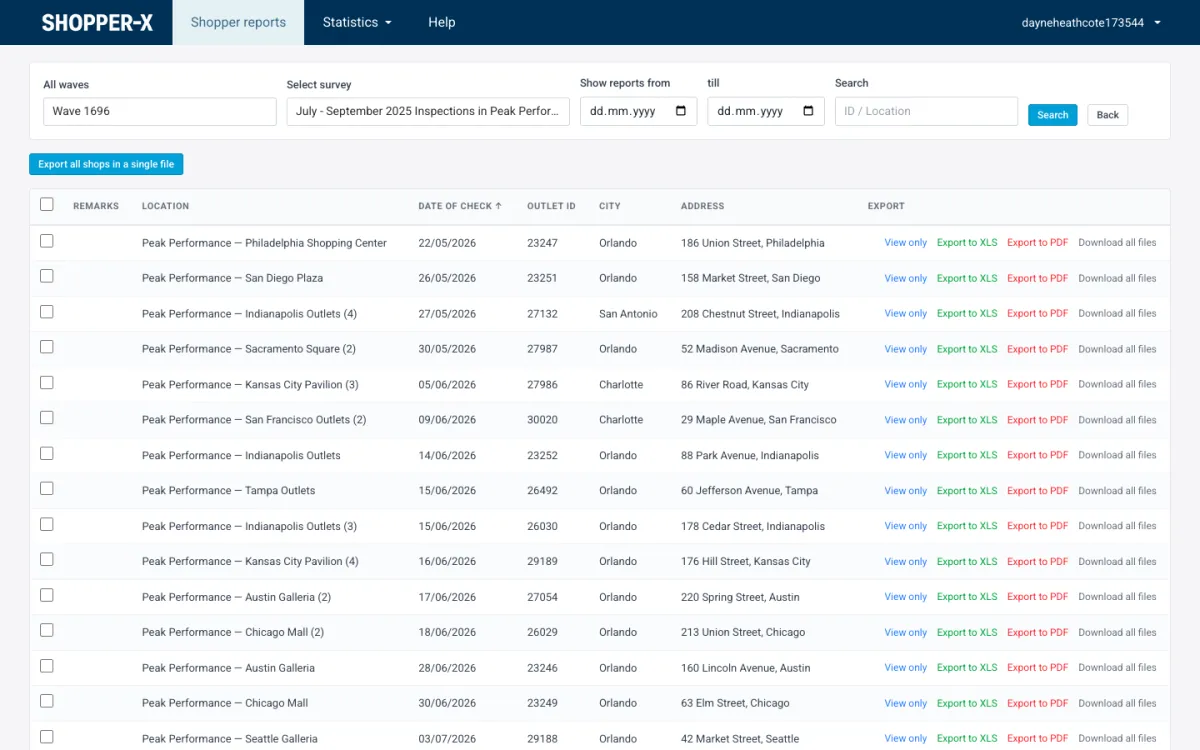
The bank's login shows one row per completed and validated visit: branch, date of the check, outlet ID, city and address, with view, XLS and PDF export and a files download per row, or all visits of the quarter in one file.
The statistics module adds the dashboard (score ring by section, regions with a trend, score per wave), the "by questions" grid with one column per wave, "by locations" for districts and branches, and the comparison view with branches side by side and a color-coded score per column. Color thresholds (red, yellow, green) are saved per user, and any view exports to XLSX, PDF or HTML with the charts embedded. For a compliance committee, the report builder pins the disclosure section across waves into one saved report, issued as a PDF or a web link with an expiry date. What the percentages mean is in mystery shopping KPIs.
FAQ
Can we keep the advisor's name and the shopper's identity out of what the bank exports?
Yes. Mark the question as containing private data and hide it in export. The validator still reads it in the report editor; the exports do not carry it.
How do we stop a report with a missed disclosure from counting as a pass?
Make the disclosure item a disqualifying question. A wrong answer disqualifies the whole report on submit, on web and mobile alike. Use the critical flag for items the bank wants singled out without failing the report.
Can the shopper be someone who is not a customer of the bank?
Yes. The shopper profile stores relationships with companies, the bank's restricted-shoppers list keeps named people out, and age and city rules are enforced when a shopper applies for a visit.
Does the bank see reports before validation?
No. The client report list holds only completed and validated visits. Reports under review, returned for corrections or marked unacceptable never appear there.
Request a demo with a questionnaire from your own branch program, or see pricing. Also see retail and automotive.