
Car dealership mystery shopping differs from a retail program in two practical ways. There are few locations, usually one dealer per town, so the same shopper cannot keep coming back. And shoppers drive a long way, so travel is part of the budget from day one. The worked example throughout: an importer with 25 dealers, one sales and one service visit per dealer per quarter, 50 audits a quarter.
What car dealership mystery shopping programs test
Importers and dealer groups rarely want opinions. They have a sales process the dealers signed up to, and they want to know whether it happens. The questionnaire asks about steps, each answered yes or no: was the shopper greeted within two minutes, did the salesperson ask what the car is for and how many kilometers a year it will do, was a test drive offered unprompted, was a written offer handed over, did anyone call within 48 hours. The service side has its own steps, covered below.
Keep sales and service in separate visits and, where possible, with separate shoppers. A shopper who brings a car for service and then asks about a new model in the showroom is memorable, and once the service advisor remembers them, both reports are suspect. The two also run on different clocks: an afternoon plus a 48-hour wait, against a booking, a drop-off and a pickup across several days.
Shopper requirements: license, car and age
A sales shopper needs a valid driving license, because the test-drive offer is the core question. The shopper also has to look plausible: a 19-year-old asking about a 60,000 euro SUV gets a different reception, and the dealer will rightly dispute the report. Set an age range per scenario.
A service shopper needs a car the dealer actually services: the right make, a model year inside the service window, and the right fuel type if the scenario is a diesel recall or a hybrid battery check. This is the hard part of automotive mystery shopping.
The way to manage it is to collect the data in the profile and gate on it. In Shopper-X the shopper profile holds the driving license and the shopper's cars with make, year and fuel, plus a list of relationships with companies used to pre-screen users and non-users of a brand. Each questionnaire has qualification gates for city, age, car and license, enforced on the server when a shopper applies for an ad. The admin shopper list filters by license and car. Building that pool is covered in how to recruit mystery shoppers and keep the good ones.
Before the wave opens, check that the gates are set for each scenario, that anyone who worked at or bought from a dealer of this brand is on the client's restricted list, and that the brief names the model to ask about and the cover story.
The sales scenario: 20 questions with weights
An example sales questionnaire with 20 questions in six sections; the weights add up to 100.
| Section | Questions | What they check | Weight |
|---|---|---|---|
| Arrival and greeting | 3 | Greeted within two minutes, names exchanged | 10 |
| Needs analysis | 5 | Use of the car, mileage, who drives it, budget, trade-in | 25 |
| Vehicle presentation | 3 | Model matched to the needs, walk-around, shopper seated in the car | 10 |
| Test drive | 3 | Offered unprompted (critical), route long enough, features shown | 20 |
| Offer and close | 4 | Written offer, financing explained, delivery time, next step agreed | 20 |
| Follow-up (answered after 48 hours) | 2 | Contact within 48 hours, by the same salesperson | 15 |
| Total | 20 | 100 |
The test-drive offer is a critical question. If the salesperson never offers a drive, the visit fails the importer's process. Mark it as critical in the questionnaire editor and require a comment so the shopper writes down what was said. Do not make it disqualifying: that throws out the whole report, and the importer still wants the rest of the data.
The follow-up question is answered later. "Did the dealer contact you within 48 hours?" cannot be answered on the day. Set the fill-in time for the sales wave to four days after the visit instead of the usual 24 hours, and tell shoppers to leave the follow-up section open until the 48 hours have passed. A shorter deadline forces a "no" because the deadline came before the salesperson's call; a longer one delays validation of the whole wave.
The service scenario
The service visit follows the customer's journey end to end:
- Booking. The shopper books a specific job. Was a price quoted, was a courtesy car offered, was the appointment confirmed in writing.
- Drop-off and write-up. Was the concern written down in the shopper's own words, was a walk-around done, was a time for the call-back given.
- Call-back. Did the advisor call before doing anything beyond the quote, and when the car was ready.
- Pickup and invoice. Does the invoice match the quote, were extra items explained, was the work explained at handover.
The invoice is the one piece of evidence a dealer cannot argue with, so set a required photo on the invoice question and flag the question as containing private data, since the invoice shows the shopper's name and plate (see mystery shopping photo evidence). Decide up front whether the program reimburses the work (entered on the audit as an other fee) or runs a quote-only visit, which is cheaper but does not test the invoice.
Travel: business trips or a flat fee
A shopper in the regional capital can cover three dealers in a day: 60 km to the first, 50 km to the second, 70 km home, 180 km in all. There are two ways to pay for that.
A flat transportation fee per audit, next to the shopper's fee: for example 15 euro for a dealer within 30 km and 30 euro beyond. Simple to budget, no receipts. It overpays the short trips and underpays the long ones, and with 25 dealers spread across a country the long ones dominate.
A business trip. The shopper groups the three audits into one trip with dates, transport type (car, public transport or other), route legs, fuel consumption and cost, and uploads the receipts. In the example: legs of 60, 50 and 70 km, a car at 7 liters per 100 km, 12.6 liters, 20.16 euro at 1.60 per liter. An admin approves the trip, the amount joins the next payment period with the audit fees, and the trip is locked once completed. The payment side is in how to pay mystery shoppers. Put the fuel rate and consumption figure in the brief, and approve trips within a week so three audit payments are not held up.
Scheduling with few locations and many scenarios
With 25 locations and two scenarios repeated every quarter, locations are scarce, so the risk is the same shopper turning up at the same dealer too often. Three things in the schedule help:
- The number of checks next to the shopper. The audit row shows each shopper with their count. When assigning the next quarter, prefer the shopper with the fewest checks for that dealer. A workable rule: no shopper visits the same dealer twice within four quarters, and nobody does both sales and service at the same dealer in the same year.
- The restricted-shoppers list per client. Shoppers who were recognized, bought a car from the network, or had a report disputed by a dealer go on the brand's restricted list. A shopper on it cannot apply for that brand's ads, and the list is the first thing to check before assigning by hand.
- Custom fields for brand and model. Add custom fields on the audit for the model to ask about ("compact SUV, hybrid") and the cover story ("trade-in of a 2018 hatchback"). The shopper sees them in the inbox. Rotate the model each quarter so four shoppers at one dealer over a year do not all ask about the same car.
Reporting to the importer and the dealer
Set up one client per brand. An importer with two brands gets two client accounts, each seeing only its own data. The 25 dealers are the locations, grouped into sales regions as districts.
The view dealers care about is the comparison: locations side by side, the overall score per dealer color-coded against thresholds (for example red below 60, yellow to 80, green above), and the per-section percentages underneath. A dealer principal who sees 58 on needs analysis next to dealers in the high 70s knows what to work on without reading twenty reports. Sales and service are separate questionnaires, so compare one at a time; a combined score hides which department is the problem.
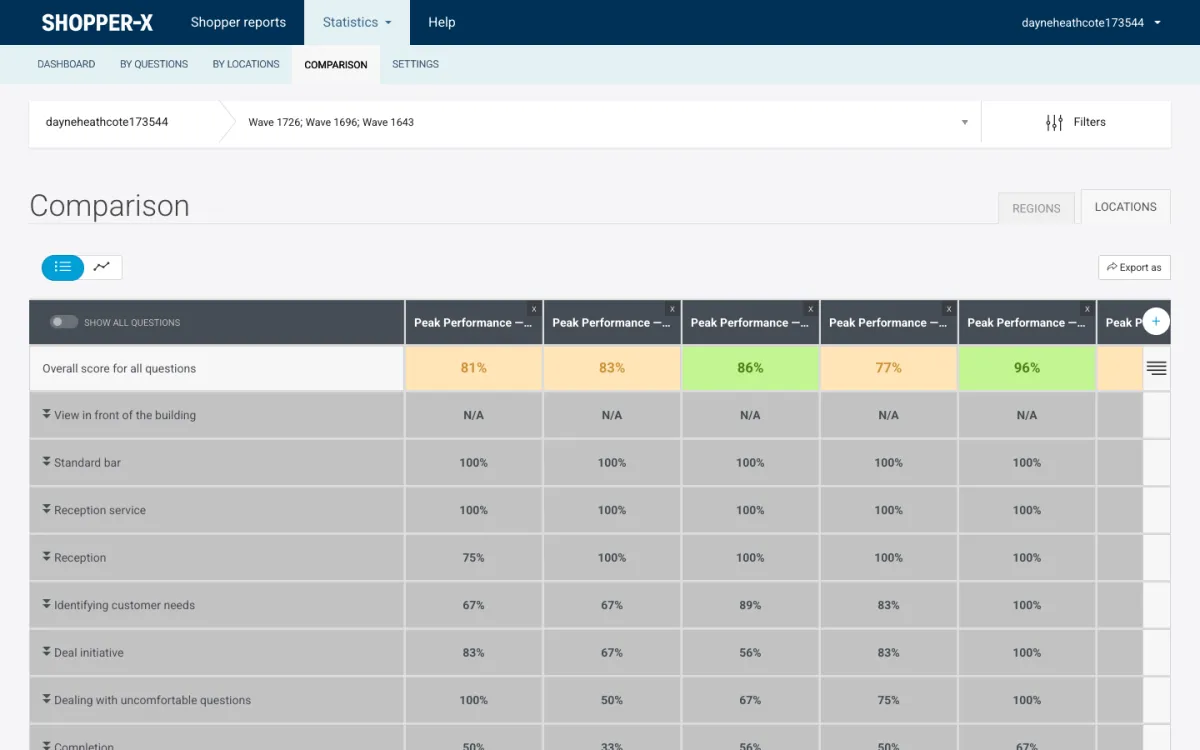
For the quarterly dealer meeting, build the report once in the report builder, save it, and issue a public web link with an expiry date. The dealer opens it in the meeting without a login, and it stops working after the review period. Running the meeting is covered in how to use mystery shopping results.
Common mistakes
- One questionnaire for sales and service, scored together. The dealer sees 71 and argues, and nobody can say which department lost the points.
- A 24-hour fill-in deadline on a scenario with a 48-hour follow-up question. The follow-up section scores zero across the network.
- No age gate on a premium brand, so half the reports are disputed as "not a credible buyer".
FAQ
Does the shopper need to own the brand's car?
For the service scenario, yes, or at least a car the dealer services: make, model year and fuel type within what the scenario needs. For the sales scenario, no. The shopper needs a license and a plausible story.
Can one shopper do sales and service at the same dealer?
Not in the same wave, and preferably not in the same year. Sales and service staff talk, and a shopper seen in both departments is remembered.
How are travel costs approved?
Either as a flat transportation fee recorded on the audit, which needs no approval beyond validating the report, or as a business trip the shopper submits with route legs, fuel consumption, cost and receipts, which an admin approves before it joins a payment period.
Shopper-X covers everything described here, from the car fields in the shopper profile to business trips and the public report link.
Related reading
- How to brief mystery shoppers so every visit follows the same scenario
- Retail mystery shopping program
- How to run a mystery shopping program
If you run or buy audits for a dealer network and want these scenarios set up with your own dealers, get in touch.