
Bank mystery shopping is the one program type where compliance reads the questionnaire before marketing does. The shopper does not buy anything. They ask about an account or a loan and write down what the advisor said about fees, rates and conditions. The worked example used throughout: 80 branches, four waves a year, two scenarios (an account enquiry and a loan enquiry), one visit per scenario per branch, so 160 visits a quarter.
Why banks run mystery shopping differently
A bank scenario still scores the greeting and product knowledge, but the items the sponsor cares about are different in kind. Did the advisor state the monthly fee without being asked? Did they mention the early repayment charge? Did they ask about income before quoting a loan amount? These are yes/no facts with legal weight. A failed one is a finding for compliance, not a coaching note for the branch manager.
That changes who designs the questionnaire. Compliance or legal reviews every item, because a badly worded question can create its own problem: "Did the advisor recommend the product" reads as if the shopper asked for personal advice, which may be regulated. Put a compliance reviewer on the questionnaire from the first draft and freeze the disclosure items before the briefing is written. A disclosure item changed mid-wave gives you two waves that cannot be compared.
The third difference is proof of visit. Retail has a receipt. A bank enquiry produces nothing, so proof of visit is a brochure, the advisor's business card, the queue ticket, or a photo of the branch front. Set the required photo on those and tell shoppers not to photograph the interior.
Scenarios for a bank branch
Account opening enquiry
The shopper is thinking of moving their salary account. Items: was the shopper asked about their needs, were the account fee and the card fee stated unprompted, was a second package offered, was a printed fee sheet handed over, was a follow-up proposed.
Loan enquiry
The shopper asks about a consumer loan, for example 8,000 for a used car. Items: did the advisor ask about income and existing credit, was the total cost or the annual percentage rate stated, was insurance presented as optional or as a condition, were early repayment terms explained, did the shopper leave with a written pre-calculation.
Complaint
A small, plausible problem: a card declined abroad, a fee the shopper did not expect. Items: was the complaint acknowledged, were the procedure and response time explained, was a reference number offered. Use it sparingly and with the bank's complaints team informed, because a staged complaint can land in the real complaints register.
Phone and web enquiries as separate questionnaires
A call to the contact center and a web-form enquiry have their own items: time on hold, whether a call-back was promised, whether it arrived. Build each as its own questionnaire in the same wave, with its own fee, working time and validation end date, so phone results do not blend into branch scores. In Shopper-X a questionnaire is a scenario with its own settings and gates; see the questionnaire builder page.
Questions that need a narrative
Yes/no items say that something happened. The narrative says what was said, which compliance can check against the tariff. Four rules:
- Open text for fees and rates. Next to "Was the account fee stated?", add an open-ended question: "Write down what the advisor said about fees, in their words." A usable answer: "The account costs 4.50 a month, waived in the first year, and the debit card is free." Set a minimum comment length so the answer cannot be "fees explained": around 150 characters for a fee statement, 300 for a loan explanation.
- Comment required on the maximum result. When the shopper gives full points for "the advisor explained the total cost clearly", require a comment. Thin reports hide in the top scores: all maximums and no words.
- Critical question for a missing disclosure. Mark the disclosure items as critical: fee stated, rate stated, insurance presented as optional. A missed critical item is flagged for the validator when the report comes in. Keep the list to three to five items agreed with compliance. If everything is critical, nothing is.
- Disqualifying question when the shopper was identified. Add "Were you asked whether you are a mystery shopper?" as a disqualifying question. A yes disqualifies the report, because the visit is no longer evidence of normal service. The shopper is still paid (say so in the briefing) and the branch gets a replacement visit.
Weights and sections are covered in mystery shopping questionnaire design; the bank-specific part is the narrative discipline above.
Private data in bank mystery shopping
A credible applicant gives a real name and sometimes a personal identification number, so the branch may now hold a lead for that person. Agree with the bank before the first wave how those records are found and removed. Inside the platform, the shopper's personal number, identity document data and IBAN are encrypted at rest.
On the report side, a photo of a pre-calculation printout may carry the shopper's name and the advisor's. Flag that question as "contains private data" and set "hide in export". The validator still sees it; the PDF and Excel the branch network receives do not. Do the same for the advisor's name if results are per branch, not per person.
One rule with no exceptions: no account numbers in reports. If the advisor opens a draft contract with an account number on it, the brief says do not photograph it; photograph the fee sheet instead. One leaked account number is a bigger incident than the program is worth.
Choosing shoppers for bank visits
An existing customer asking to open an account is an odd visit: the advisor sees their accounts on screen. The shopper profile in Shopper-X has a "relationships with companies" field where shoppers declare which banks they use. Filter on it to pick non-customers of the sponsor, or customers of a competitor for a "switching" variant.
A loan enquiry from a 19-year-old with no income history gets a different conversation than one from a 38-year-old. Set the age gate per questionnaire, for example 25 to 55 on the loan scenario and 18 and over on the account scenario, and spread the ages so the results do not describe one segment.
Vocabulary is the third filter. A shopper who does not know what the annual percentage rate or a fee sheet is will write a narrative compliance cannot use. Run an industry qualification for banking: a short document on the vocabulary, what to ask and what not to sign, with a test. It stays valid for 6 or 12 months, then the shopper sits it again. On top comes the task instruction per scenario: the story, the amounts, the exact questions, as described in how to brief mystery shoppers. One line belongs in every bank brief: never sign anything. The shopper takes the paperwork home "to think about it".
Bank branch mystery shopping program outline
The 80-branch example as one quarterly wave: a six-week visit window, reports due within 48 hours, and a validation end date two weeks after the last visit so compliance gets a closed dataset.
| Questionnaire | Visits per wave | Visit window (Q1 2027) | Report deadline | Validation end | Results go to |
|---|---|---|---|---|---|
| Account enquiry, branch | 80 | Jan 12 to Feb 20 | Within 48 hours | Mar 6 | Compliance; branch network |
| Loan enquiry, branch | 80 | Jan 12 to Feb 20 | Within 48 hours | Mar 6 | Compliance; branch network |
| Loan enquiry, contact center (optional) | 40 | Jan 19 to Feb 13 | Within 24 hours | Mar 6 | Compliance; contact center |
Assignment rules: no shopper visits the same branch twice in a year, and the two scenarios on one branch go to two different shoppers. With 40 qualified shoppers that is four visits each per wave. If the sponsor wants a branch score rather than a network score, one visit per scenario is not enough; see mystery shopping sample size for the trade-off.
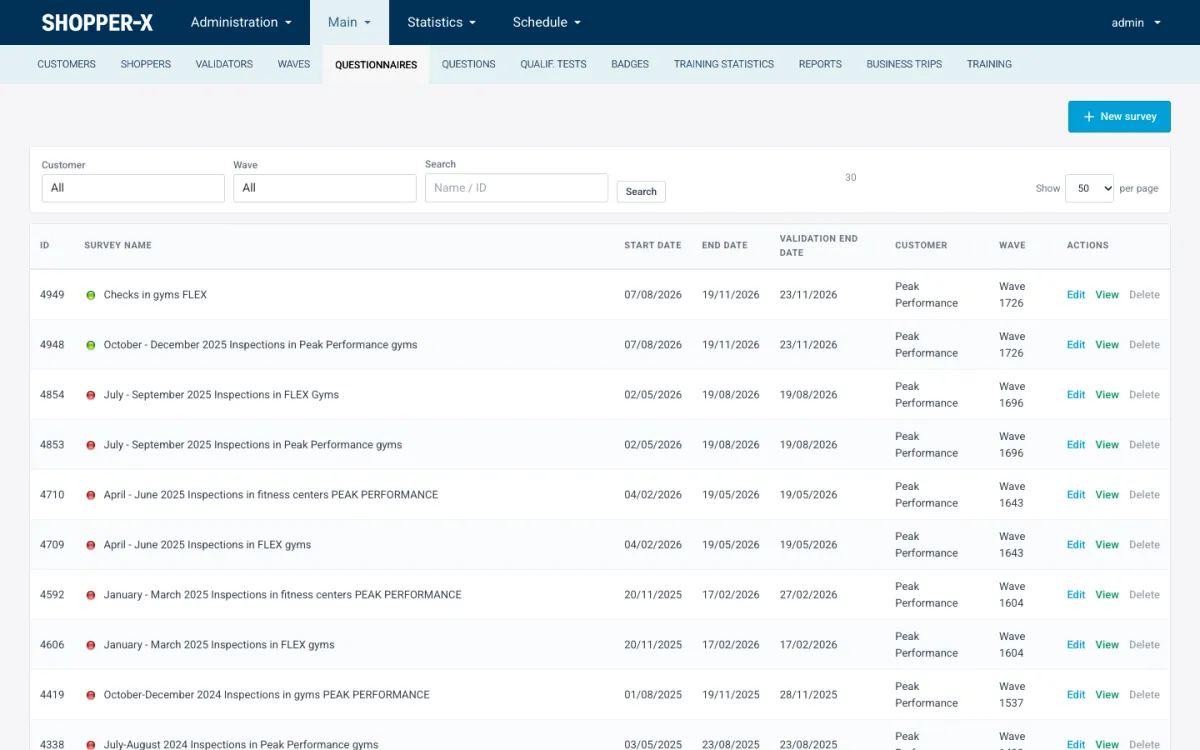
Each questionnaire carries its own start, end and validation end date, so a late phone wave does not hold up the branch results. The questionnaire list shows the three dates next to the customer and wave.
Client access by region: the head office login sees the bank's data only, and only validated reports. A regional head opens the same statistics with the district filter set to their region, and the comparison view puts districts side by side.
Reporting to compliance and to sales
Compliance wants the disclosure items and nothing else. Open the "By questions" grid, filter to the disclosure section, and switch on "show problematic" so only the cells under the threshold stay visible. In the example that might read: "Rate stated unprompted" at 61% across the network, two regions under 50%. Then export the individual reports behind the red cells; compliance will ask for the narrative.
The branch network wants section scores: welcome and waiting, needs analysis, product explanation, closing and follow-up. Per region, per branch, trend across waves, with the color thresholds the bank agreed (for example red under 60%, yellow 60 to 80%, green above). Give a branch manager their own items with the narrative, not a league table of compliance failures.
For the quarterly steering meeting, a PDF export of the dashboard with the charts embedded is enough, and a saved layout in the report builder produces the same pack every quarter. The views are on the reporting page; what to do with the numbers afterwards is in how to use mystery shopping results.
FAQ
Can shoppers record the conversation?
Recording is not a platform feature, and recording without consent is a legal question for the bank's lawyers. The working standard is a written narrative entered right after the visit, with a minimum length, checked by a validator against the tariff and the brief.
How do we handle a branch that identifies the shopper?
The disqualifying question handles the report: it is disqualified, the shopper is paid, and a different shopper visits two to three weeks later. If it happens at several branches of one region in one wave, the scenario is burned and needs a new story before the next wave.
Get compliance in early, keep the critical list short, pick non-customers who know the vocabulary, and close each wave on a fixed date. The flags, dates and views above are standard parts of Shopper-X.
Related reading
- Mystery shopping questionnaire design
- How to brief mystery shoppers
- Setting up a retail mystery shopping program
To see the compliance view and the branch view come out of one wave with your own scenarios, contact us and we will set it up.